JBO – Batching Oil: Soybean Oil as Modern, Safe Alternative in Premium Jute Rope Production
When you work with natural fiber ropes for Shibari and Kinbaku, you will quickly come across JBO – Jute Batching Oil.
Batching is a critical step in jute processing: raw jute fiber bundles are treated with an emulsion of oil, water and emulsifier to make the fibers pliable and to optimize spinning and twisting quality.

What is batching and why is it technically essential?
In the batching house the jute reeds are spread on a porous conveyor belt and sprayed with the emulsion. Typical application rates are 15–25 % emulsion based on fiber weight, resulting in a final oil content of approx. 2 % in the yarn. The fibers are then piled – usually 24 to 48 hours, up to 72 hours for lower grades. During this time the moisture (14–16 %) penetrates deeply, softening the lignin structure and significantly increasing tensile strength during carding and spinning.
Traditional mineral JBO – technical specifications and risks
Conventional JBO is a middle-distillate petroleum product (C12–C20 hydrocarbons) meeting Indian Standard IS 1758:1986 (Type 1/2).
Key values include:
- Density at 15 °C: ≥ 0.850 g/cm³ (max. 0.900)
- Kinematic viscosity at 37.8 °C: max. 15–25 cSt
- Flash point (PMCC): ≥ 54 °C (often > 121 °C)
- Pour point: ≤ –9 °C (winter) / ≤ 21 °C (summer)
- ASTM color: max. 7.0
The emulsion is usually prepared at 25 % oil : 73.5 % water : 1.5 % emulsifier (e.g. non-ionic).
Carcinogenic properties of mineral JBO – findings from the Mehrotra studies (1979–1989)
An extensive series of scientific investigations by the NK Mehrotra research group has thoroughly analysed the health risks of mineral jute batching oil. The 1979 study found no direct carcinogenic changes in mouse skin or internal organs after 300 days of topical JBO application alone; UV and IR spectroscopy detected no polycyclic aromatic hydrocarbons (PAHs).
However, a clear co-carcinogenic effect was observed: JBO significantly shortened tumour development time when applied together with the known carcinogen benzo[a]pyrene. Subsequent studies (1982–1989) provided conclusive evidence of both tumour-initiating and, above all, strong tumour-promoting properties. JBO-P contains PAHs, particularly higher-condensed fractions with more than three rings, which are responsible for inducing benign skin tumours (papillomas, keratoacanthomas and fibrosarcomas) in two-stage mouse-skin carcinogenesis models.
The JBO-P variety proved to be a complete carcinogen or potent promoter. In addition, JBO induces enzymes such as benzo[a]pyrene hydroxylase and acts via oxidative stress mechanisms.
Soybean oil as vegetable, hydrocarbon-free alternative
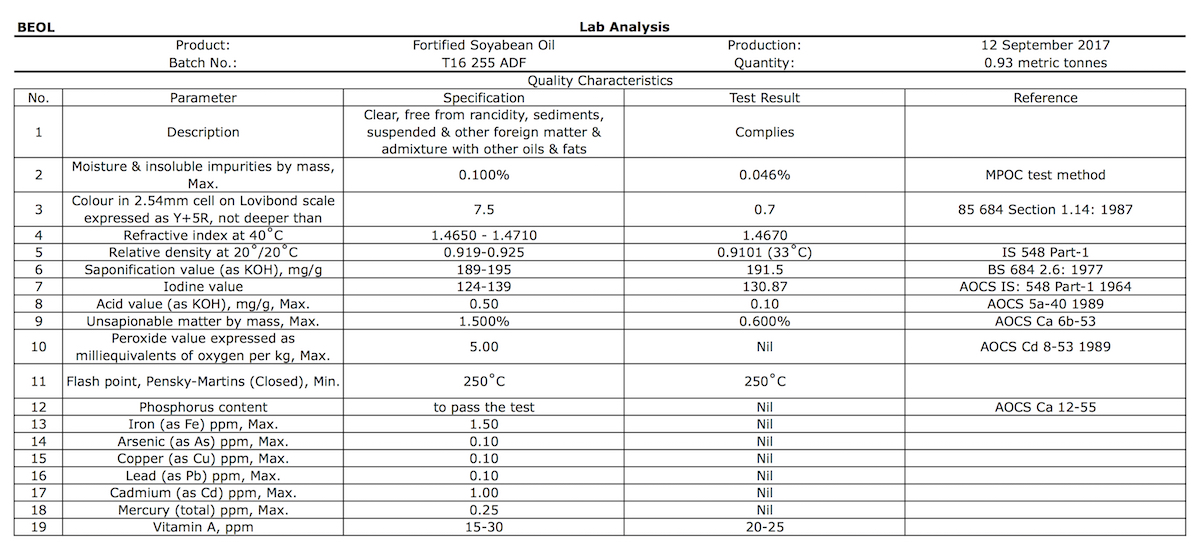
Soybean oil serves as a vegetable-based, hydrocarbon-free, biodegradable alternative in jute processing (softening and lubricating raw jute filaments before spinning). It is typically an edible-quality refined or cold-pressed soybean oil, often used in an oil-in-water (o/w) emulsion with a non-ionic emulsifier. It avoids the carcinogenic PAH concerns of mineral JBO, making it suitable for food-contact jute products.
AMATSUNAWA exclusively uses 100 % cold-pressed, Vitamin A/D fortified, GMO-free soybean oil (CAS 8001-22-7).
Typical values (from current data sheets of ADM, Perdue and Corechem):
- Density at 25 °C: 0.917–0.925 g/cm³
- Viscosity at 40 °C: approx. 39 cSt (at 25 °C: 45–55 cP)
- Iodine value: 124–139 g I₂/100 g (high unsaturated fatty acids, mainly linoleic acid 50–57 %)
- Flash point: > 300 °C (closed cup)
- Free fatty acids (FFA): < 0.05 %
- Peroxide value: < 1 meq/kg
- Moisture content: approx. 0.08 %
The oil is GRAS-certified, fully biodegradable and completely odorless. Natural tocopherols provide excellent oxidative stability.
Current research: SBO vs. mineral JBO emulsion (2023 study)
A 2023 study on wastage analysis in jute spinning compares SBO-based emulsion with traditional mineral JBO. Key findings:
- Moisture content: ~0.08% (vs. 0.4–0.5% for mineral JBO).
- Application: 18% emulsion (on weight of jute fiber) applied via spreader machine, targeting ~2% oil on final yarn. Same recipe/emulsifier as JBO.
- Characteristics: Lower lubricity and lower moisture retention than mineral JBO, leading to higher fiber breakage and dust in processing (overall wastage ~3.36% higher). However, it is eco-friendly and reduces health risks.
- Process context: Applied to raw jute (e.g., 60% hard + 40% soft), followed by 48-hour conditioning at ~40°C for softening via microbial action on lignin. Used for producing yarns like 16/1 lb/sp.
The study confirms: Although processing generates slightly more waste, the advantages in safety, odorlessness and biodegradability clearly outweigh this.
Current batching procedures at a glance
- Batch selection: Blending different jute grades for uniform yarn quality.
- Emulsion preparation: Soybean oil is homogenized with non-ionic emulsifier and water.
- Application: Sprayed finely in the softener (long fibers) or spreader (short fibers) – typically 18% with SBO.
- Conditioning: Piling and resting 24–72 hours (often 48 h at ~40 °C) for even moisture uptake and microbial softening.
- Further processing: Carding, drawing, spinning and twisting into high-quality single-ply yarns.
Benefits for Shibari and Kinbaku ropes
Using soybean oil guarantees odor-free, skin-friendly and durable ropes. No mineral oil residues, full skin-contact compatibility and complete biodegradability – perfect for demanding users. AMATSUNAWA deliberately chooses this premium vegetable oil option and delivers ropes that meet the highest safety and quality standards.
And don't forget: If your rope smells of kerosene, it contains harmful JBO.
Book recommendations
- From Rope to Ties: Processing Hemp and Jute Rope for Shibari by JE Earl – practical guide to processing jute and hemp ropes (paperback and Kindle).
- Jute And Its Manufacture by Herbert R. Carter – classic on the entire jute processing chain (available as paperback).
- Modern Flax, Hemp, And Jute Spinning And Twisting – detailed technical foundations of fiber spinning.
Sources:
- Mehrotra NK, Saxena AK. Evaluation of carcinogenic effect of mineral oil used in the processing of jute fibres. Br J Exp Pathol. 1979;60(5):518-525.
- Kumar S, Antony M, Mehrotra NK. Induction of benzo[a]pyrene hydroxylase in skin and liver by cutaneous application of jute batching oil. Cancer Lett. 1982;16(3):311-317.
- Agarwal R, Kumar S, Shukla Y, Antony M, Mehrotra NK. Quantification of tumour initiating effect of jute batching oil and its distillates over mouse skin. Cancer Lett. 1985;28(3):307-313.
- Agarwal R, Kumar S, Mehrotra NK. Polyaromatic Hydrocarbon Profile of a Mineral Oil (JBO-P) by Gas Chromatography. Indian J Exp Biol. 1986;24(11):731-733.
- Mehrotra NK, Kumar S, Agarwal R, Antony M. Jute batching oil: a tumor promoter on mouse skin. Environ Res. 1987;44(1):107-116.
- Agarwal R, Shukla Y, Kumar S, Mehrotra NK. Evaluation of carcinogenic effect of jute batching oil (JBO-P) fractions following topical application to mouse skin. Cancer Lett. 1988;42(1-2):53-59.
- Mehrotra NK, Kumar S, Antony M. Carcinogenic Property of JBO(P) Variety of Jute Batching Oil. Drug Chem Toxicol. 1988;11(2):181-193.
- Antony M, Kumar S, Mehrotra NK. Role of GSSG-reductase and a thiol oxidant diethylmaleate (DEM) in skin tumorigenesis induced by jute batching oil. Cancer Lett. 1989;44(3):211-216.
- Investigation on Wastage Analysis of Jute Fiber Spinning Using JBO and Soybean Oil Based Emulsion (Shoaib Islam Zico et al., 2023).
- IS 1758:1986 – Jute Batching Oil (Bureau of Indian Standards).
- Technical data sheets soybean oil: ADM, Perdue AgriBusiness, Corechem (2021–2025).
- AMATSUNAWA internal specifications and production data.